


Are You Deceived?
You have been told that the bible is infallible. It claims to be a book without error; a message to mankind written by the very hand of God; the authors being only the instruments used to pen it. Scholars try to convince us that the bible is a book that we can trust as ‘the word of God‘.
To criticize the bible and declare it a book written by mere men is sacrilegious at best. At worst you are an agent of the Devil or, maybe even, the Devil himself. But is the holy book all that it claims to be? Can we rely on the ‘sacred‘ text to dispense to us the absolute words of God?
All scripture is given by the inspiration of God,
What The Bible Claims To Be
- It can withstand scrutiny.
- It is the inerrant word of God.
- We can rely on it to provide us with historical information which can be collaborated.
- The Old Testament prophesied the Messiah, thereby proving that Jesus was actually the one the Jews were looking for.
- The scriptures as we have them today are as close as any book can get to the original. They have not been tampered with.
- Jesus and all the other characters are actual historical persons who lived in time and space.
- The books are authored by the very persons whose names the books are ascribed to.
- It is miraculously synchronized and there are no contradictions.
We shall examine each one of these claims, to see if they are able to withstand the litmus test. If in the end, the bible is able to withstand its appearance on the witness stand, then we shall have no choice but to accept its claims as the infallible word of God. Should it not be able to do so, then we will have to reject it as such. It will also mean that all that it testifies to, cannot be accepted as the ‘gospel truth’. Are you ready? Let us begin.
The First Canon of Scriptures
Marcion, a rich shipper, compiled the first canon (canon means authorized version) of scripture at around the beginning of the 2nd century. Marcion was the son of a bishop and was himself a bishop. What’s more important though, is that Marcion was a Gnostic. Now let me explain.
The first Christians were Gnostic. Gnostics do not believe in a physical Christ. They generally hold the belief that the Christ is a state of being. It is not a specific individual but rather anyone who reaches an elevated state of consciousness. So any canon compiled by Marcion would not refer to a physical man named Jesus as the Christ.
Another interesting tidbit is that Marcion did not accept the God of the Old Testament. He believed him to be a wicked, evil, bloodthirsty, genocidal, vindictive being. By contrast, however, he accepts the loving concept of the God of the New Testament. To Marcion, the Old Testament God is the God of the Jews, but certainly, not the God Christ represents.
Marcion’s (The Gnostic) Bible
In Marcion’s bible, Paul is the only apostle he acknowledges, with the addition of a shortened version of the Gospel of Luke (he omitted the first two chapters and other parts) and the book of Acts. He rejects outright the books of the Old Testament. Of the other books of the New Testament, Marcion only accepts twelve. The others he completely rejects.
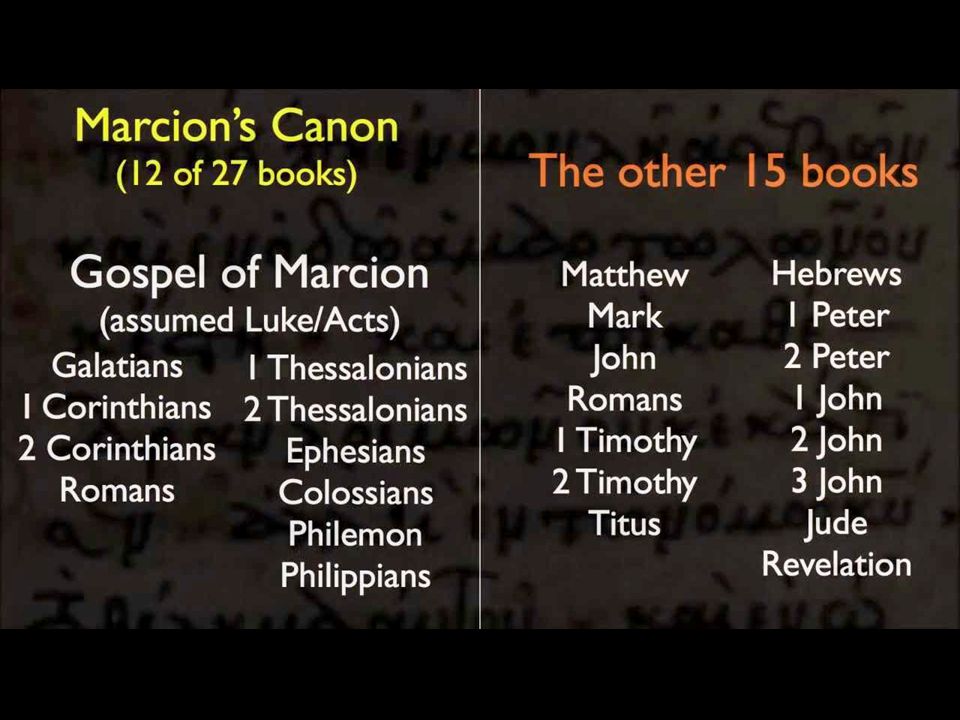
He cautioned though, that one still had to be careful because it is highly likely that even those writings are tamped with.
Your Bible – The Church’s Response
Now, this is where the fun begins. In response to Marcion’s canon, the Roman church then saw the need to develop it’s own. Irenaeus undertook the task to so do. Ireneaus lived in the second and third centuries. He is the first to insert the gospels of John, Mark, and Matthew in the canon, ascribing to them divine inspiration.
He is also the first to name the four (4) gospels and ascribe authors to them. Previous to this the gospels were anonymous. In other words, they were nameless and authorless. Stated plainly, we have no idea who wrote the books of the four gospels. It is also important to remember that there were hundreds of texts making the rounds at this time, most of them without the name of the author. Some of these writings existed many centuries before the time Jesus supposedly live.
Why Four (4) Gospels?
Now, why 4 gospels and not 3; or perhaps 2; or even 5; for that matter? Well, here is an answer that is sure to surprise you. You see Ireneaus in his great wisdom decided that since there are four cardinal points you need to have four gospels. Yep! That’s how you now have four gospels.

Also included was the Shepherd of Hermes
Athanasius Finishes The Bible
Athanasius is credited with compiling the final canon of 27 books. It is interesting to note at this point, for many centuries the book of Revelation was rejected by scholars. The reason? They claim that it is pure rubbish and written in very poor Greek. It also does not, in any way, match the style of writing of the author of the Gospel of John. Therefore John could not be its author. The reason, however, that the church wanted it included, is because it speaks of hell and judgment. Therefore believers would not believe they could live as they chose. In other words, they wanted to be able to frighten individuals into being followers.
Athanasius, like Irenaeus, was concerned mainly with the propagation of Catholic doctrine and the advancement of the Catholic church, not the integrity of ‘the word of God’. Here is what the Catholic Encyclopedia has to say of Athanasius:
Athanasius was the greatest champion of Catholic belief …that the Church has ever known
There is More To Come
Are you still convinced that the bible is actually ‘the word of God’ given to us by God’s very hand? Even if you are not yet moved, this is only the beginning. The real excitement is yet to come. Look out for part two next as we shall continue to explore the sacred text.
You may also want to read: Passover? Easter – Could You Be Celebrating A Goddess Fertility Festival?